


A brand manager trying to test a new TV spot doesn’t need a pricing study. A product team trying to understand category dynamics doesn’t need an ad recall survey. Knowing the difference lets you ask better questions, spend smarter, and get insights that actually move the needle.
This post breaks down what separates advertising research from market research, where they genuinely overlap, and how to decide which one you need.
Market research is the broad discipline of gathering information about a market. It includes consumers, competitors, trends and dynamics to support any business decision.
Advertising research is a focused subset of market research. It is specifically concerned with how advertising communicates, persuades, and performs before, during, and after a campaign.
Think of it this way: market research is the entire ocean. Advertising research is a specific current within it.
What Is Market Research?
Market research is any systematic effort to understand the environment a business operates in. It covers:
- Consumer behavior: what people buy, why they buy it, when, and how often
- Market sizing: how large is the opportunity as per the size of target audience ?
- Competitive landscape: who else is competing for your customer and how?
- Product development : does this new product idea solve a real problem?
- Pricing strategy: what are consumers willing to pay, and what price signals quality?
- Distribution and channel preferences: where do consumers expect to find and buy products?
- Brand equity: how is your brand perceived relative to competitors?
Market research informs the entire business strategy. It answers questions like: Should we enter this new category? Which consumer segment should we prioritize? Is there unmet demand for a product we haven’t built yet?
The output of market research is typically a strategic recommendation: enter this market, price at this level, target this segment.
What Is Advertising Research?
Advertising research is concerned with one thing: communication effectiveness. It asks whether your advertising is reaching the right people, with the right message, in a way that sticks and drives action.
It is used to:
- Pre-test creative before media spend, does the message land? Is the brand clear? Is there a strong call to action?
- Compare execution options: which tagline, visual, or format performs best with the target audience?
- Monitor in-market performance: Are the right audiences seeing the ad, and are they responding?
- Measure post-campaign impact: did brand recall improve? Did purchase intent shift? What changed in consumer perception?
- Diagnose underperformance: an ad ran, but results were weak. Why? What needs to change?
The output of advertising research is a creative or campaign recommendation: use this execution, adjust this message, discontinue this format, reallocate spend to this channel.
Ad Research vs Market Research:
In practice, the best marketing teams run market research and advertising research as a continuous loop, not separate projects. Market research sets the strategic context; advertising research refines the execution.
Market Research | Advertising Research | |
Primary focus | The market, consumer, and competitive environment | Ad content, messaging, and campaign performance |
When it’s done | Ongoing; before major business decisions | Before, during, and after ad campaigns |
Questions it answers | Who is my customer? What do they need? What should I build or price? | Does my ad work? What message resonates? Did the campaign shift perception? |
Typical methods | Surveys, ethnography, focus groups, secondary data, interviews | Creative testing, brand lift studies, recall surveys, A/B testing, focus groups |
Typical stakeholders | Product, strategy, leadership, brand | Marketing, brand, creative, media planning teams |
Output | Market entry decisions, product roadmap, segmentation, pricing | Creative recommendations, campaign optimization, media decisions |
Time horizon | Often long-term and strategic | Campaign-specific and tactical |
Where they overlap
Brand equity studies sit at the intersection. Understanding how consumers perceive your brand is core to market research. It also directly informs how advertising should position the brand. A brand seen as trustworthy but boring needs advertising that adds energy. A brand seen as innovative but inaccessible needs advertising that builds warmth. You can’t brief a creative team without this insight.
Consumer segmentation is typically a market research deliverable. It also defines who advertising targets. Knowing that Segment A responds to aspiration and Segment B responds to value changes everything about creative development and media planning.
Category and competitor insights from market research tell you what territory your advertising needs to claim. If a competitor owns “reliability” in the consumer’s mind, your advertising research needs to test whether you’re successfully carving out a different position.
Common mistakes when you confuse the terms
Mistake 1: Running broad market research when you need a quick creative decision.
A brand manager needs to decide between two ad concepts by Friday. Commissioning a full market segmentation study is the wrong tool. What they need is a fast concept test with a representative sample of the target audience (a classic advertising research method).
Mistake 2: Using ad testing to answer strategic market questions.
Testing whether consumers prefer your new ad over a competitor’s ad tells you about relative creative performance. It doesn’t tell you whether there’s demand for your product, whether you’re priced right, or whether a new segment is worth pursuing. Advertising research cannot replace market research.
Mistake 3: Skipping market research before briefing the creative.
Advertising research can tell you if an ad works, but it can’t tell you if you’re talking to the right people with the right strategic message. If you avoid the basic market research, you will not know who your real consumer is.
Mistake 4: Measuring only campaign KPIs and calling it advertising research.
Click-through rate and impressions are media performance metrics. Advertising research goes deeper. It asks why a campaign performed the way it did, what consumers understood from it, what changed in their perception or intent, and what to do differently next time.
Ad Research or Market Research: Which One Do You Need?
A simple heuristic:
Use market research when the question is strategic.
You’re making a decision about your business, your product, your pricing, your target audience, or your brand positioning. The output will inform a plan that spans months or years.
Use advertising research when the question is about a campaign or creative.
You’re making a decision about what to communicate, how to say it, whether it landed, and how to improve it. The output will inform a specific campaign or creative brief.
Use both when they’re connected:
The most effective advertising research is grounded in solid market understanding. The best market research is eventually translated into communication, which advertising research then helps to refine.
How Merren Supports Both
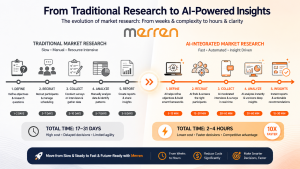
Merren’s AI-powered market research platform is built for exactly this kind of work. Fast, deep, scalable consumer conversations that inform both strategic and campaign-level decisions.
For market research, Maya AI conducts in-depth interviews with consumers at scale. You can explore brand perception, map the competitive landscape through consumer eyes across geographies, in multiple languages. In days rather than weeks.
For advertising research, Maya AI tests concepts, messaging, and creative stimuli with real target audiences. Upload an ad, a storyboard, a tagline, or a campaign concept. Maya probes for comprehension, emotional response, brand linkage, and persuasion.
Both flows produce transcripts, AI-synthesized themes, and ready-to-download reports. One platform. Both research needs.
Frequently Asked Questions
Is advertising research a type of market research?
Yes. Advertising research is a specialized form of market research focused specifically on advertising content, messaging, and campaign performance. All advertising research is market research, but not all market research is advertising research.
Can the same survey cover both?
Yes, with careful design. A survey can include questions about brand perception (market research) alongside questions about a specific ad’s recall and message clarity (advertising research). The key is to keep the objectives clear and avoid conflating findings.
Which should you invest in first?
If you’re entering a new market or targeting a new segment, invest in market research first. You need to understand the consumer and competitive landscape before you can create effective advertising. If you’re refining an existing campaign or deciding between creative options, advertising research is the priority.
How long does each take with AI-powered tools?
With platforms like Merren, both types of research can deliver first insights within 24–48 hours of launching interviews. Traditional timelines no longer apply when AI moderates interviews at scale.
The brands that get the most value from consumer research are the ones who know exactly which question they’re trying to answer before they start and choose their research method accordingly.
If you’re ready to run faster, more affordable research for either need, explore how Merren’s Maya AI works here.