


You have a campaign brief, creatives and a launch date. What you do not have is proof that any of it will work with the audience you are trying to reach.
That gap between what a creative team believes resonates and what a real audience actually feels. This is where ad spend gets wasted. The conventional solution is advertising research: recruit respondents, schedule focus groups, moderate sessions, transcribe, code, analyse, present. Weeks pass while budgets shrink and deadlines slip.
Maya AI by Merren was built to close that gap without sacrificing the quality of insight. This blog explains how Maya approaches ad testing and advertising research differently. What that means for brands that need audience validation before they commit to media spend.
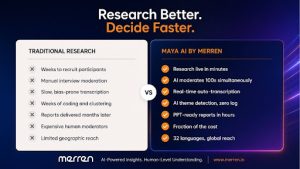
Advertising Research Comes With A Cost (and Problems)
Friction from traditional advertising research makes it difficult to assess. Most advertising teams know they should be doing more pre-launch research. The barriers are consistent across organisations of every size:
- Time: A well-executed qualitative study recruits, moderation, analysis, reporting. This takes three to six weeks minimum. Most campaign timelines do not accommodate that.
- Cost: Human moderators, research agencies, focus group facilities and transcription services add up quickly. For smaller campaigns, the research budget alone can exceed the creative budget.
- Scale: Traditional qualitative research works with small samples typically 8 to 15 respondents. Statistically meaningful patterns across audience segments require much larger numbers.
- Consistency: Different moderators ask questions differently. Different sessions produce data that is hard to compare. Synthesis is subjective.
- Actionability: Even when research is done well, translating a 40-page research report into a single creative decision is not straightforward.
What this means for ad testing
Ad testing is validating creatives, concepts, copy and messaging with your target audience before media investment. It is skipped because the traditional process makes it incompatible with real campaign timelines and budgets.
Ad research has structural constraints. They explain why so many campaigns launch without ever speaking to the people they are meant to persuade.
Maya AI Conducts Ad Testing at Scale
The distinction matters because the quality of insight from a qualitative interview depends on follow-up. When a respondent says a creative feels ‘too corporate’, the insight is in the next question: what specifically feels corporate: Is it the colour palette? The language? The spokesperson? A fixed survey cannot ask that question but Maya AI can.
Here is what Maya does in an ad testing or advertising research context:
1. Operates from a structured discussion guide
Every study runs from a researcher-approved discussion guide that defines the objectives, question flow, and key probe areas. The guide can be customised by the research team. Maya executes it consistently across every respondent.
For ad testing studies, this typically includes:
- Initial exposure to the creative (concept, storyboard, finished asset, or written description).
- Unprompted first reaction: what the respondent noticed, felt, and understood.
- Prompted evaluation: clarity, relevance, credibility, emotional response, purchase intent.
- Comparative evaluation where multiple creative variants are being assessed.
- Open-ended probes on specific elements: message, visual, tone, spokesperson, CTA.
2. Conduct AI moderated interviews at scale
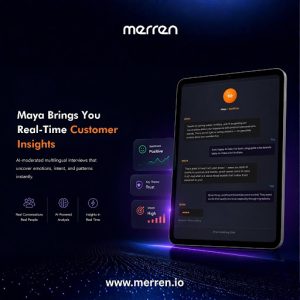
For an ad testing study, this means your target audience participates in their own environment, at a time that suits them, in a format that does not feel like formal research. Maya’s conversational moderation can capture speech along with emotional metrics. This format of interaction does not feel like a formal research. The result is minimal bias and more human interaction.
3. Adapts based on what respondents say
This is the core capability that separates Maya from a survey tool. When a respondent reacts to a creative with confusion, Maya probes the confusion. When a respondent expresses strong positive emotion, Maya explores what specifically drove that response.
For advertising research, this means the data you receive is not just ‘Creative B scored 7.4 out of 10 on relevance.’ It is the verbatim language respondents used, the specific elements they noticed, the associations the creative triggered, and the reasons behind the scores.
4. Generates and compiles comprehensive reports
When fieldwork closes, Maya does not produce a pile of transcripts waiting for a human analyst. It produces a synthesised report: themes clustered from across all respondents, verbatim quotes surfaced by theme, sentiment analysis and a plain-language summary of what the data means for the creative decision.
Depending on study size, this analysis is available within hours of the last interview completing, not days or weeks.
How Merren’s Maya AI Approaches Ad Testing
For a brand or agency running ad testing with Maya, the workflow looks like this:
- Define the research objective. What is the campaign for? What audience are you targeting? What specific decision does the research need to support? Which of four creative routes to proceed with or whether the core concept resonates before production begins?
- Build the discussion guide. Merren’s team works with you to structure the interview guide around your specific ad testing objectives. For concept testing, the guide focuses on first response, clarity, and emotional reaction. For creative testing with finished assets, it adds elements like message recall and intent.
- Define and recruit the sample. You specify the audience characteristics: demographics, geography, category relationship, behavioural attributes. Merren recruits respondents who match that profile.
- Maya conducts the interviews. Respondents receive the interview via WhatsApp. Maya guides each respondent through the discussion guide, probing intelligently based on what each person says. Each interview runs in 10 to 20 minutes.
- Maya analyses and reports. Across all completed interviews, Maya clusters themes, surfaces verbatim responses, scores key metrics, and generates a summary report ready for stakeholder presentation. No manual coding. No analyst bottleneck.
- The creative team acts on the findings. The report directly addresses the research question: which creative resonates, what works, what does not, and the language the audience uses that could strengthen the final execution.
Case Study: Ad Creative Testing For A Corporate Program Launch
Creative validation for a major corporation’s programme launch
Background
A large corporation was preparing to launch a new programme. The in-house team developed four creative directions: each with a distinct visual identity and tone. Before committing to production at scale, the leadership team needed to know which creative would resonate with their core viewer audience.
The challenge
The team had four creative options and no objective basis for choosing between them. Internal reviews were split. Stakeholder preferences were divided. They needed audience data to understand:
- Which creative best communicated what the programme was about
- Which one generated the strongest emotional resonance with target viewers
- Could the audience differentiate the text/ color differences among the creatives
- Whether any of the four options had elements worth carrying forward into the final production
The research design
Merren designed an ad testing study using Maya AI. The discussion guide was built to showcase all four creative options in randomised order. This eliminates order bias and walks each participant through a structured evaluation order.
After the structured evaluation, Maya probed for the specific language respondents used to describe each option: what it reminded them of, what feelings it triggered and what they felt was missing.
Fieldwork
Maya conducted interviews with a representative sample of the programme’s target viewer demographic via Maya’s AI moderator. Every participant shared their verbatim reactions to each creative unprompted first response, followed by Maya’s adaptive follow-up probes based on what each person said. The result was not a set of ratings scores but a rich body of qualitative data that captured exactly how real audience members experienced each creative option.
What Maya produced
When fieldwork closed, Maya’s analysis engine processed all interviews simultaneously and generated a comprehensive stakeholder report. The report included:
- A ranked summary of all four creatives against the key evaluation dimensions
- Verbatim quotes clustered by theme: what respondents said about each creative in their own words
- A clear identification of which creative generated the strongest resonance with the concept
- Specific elements from lower-ranked creatives that respondents responded positively to which the production team incorporated into the final execution
- Sentiment and emotional response data segmented by key audience sub-groups
The outcome
The corporation went into their programme launch with a creative decision backed by audience data. The entire research process from brief to final report was completed in five days.
Maya For Advertising Research: Beyond Concept Testing
Ad testing is one application of Maya’s capabilities. Advertising research is broader, and Maya can support the full research lifecycle that sits around a campaign.
Pre-campaign audience research
Before a brief is written, brands need to understand how their target audience perceives the category, the brand, and the competitive landscape. Maya conducts this discovery research at scale. Maya interviews hundreds of respondents across segments to surface the attitudes, language, and unmet needs that the campaign strategy should be built on.
This is market research for advertising in its truest form: qualitative depth across a statistically meaningful sample, delivered before the agency briefing rather than weeks after launch.
Message and positioning testing
Before committing to a campaign message, brands can test whether it lands with the target audience. Maya presents positioning statements, value propositions, or tagline options and probes for resonance, clarity and differentiation. Which message creates the most compelling reason to act? Which one is most credible coming from this brand?
Post-campaign effectiveness research
After a campaign runs, brands need to understand whether it worked in terms of brand perception, message recall, and audience attitude shift. Maya conducts post-campaign interviews that provide the qualitative dimension of advertising effectiveness research that performance metrics cannot capture.
Continuous audience tracking
For brands running campaigns across multiple markets, Maya enables longitudinal research that would be expensive with traditional methods. The same discussion guide deployed across waves produces comparable data, tracking how audience perception of the brand and its advertising evolves.
Validate Your Ad Creative Before Production
The question ‘will this ad work?’ is answerable before your media plan is locked, before production wraps, before a single dollar of media spend goes out.
Ready to test your next campaign creative with your actual target audience? Maya AI conducts the interviews, captures the verbatim responses, and delivers the analysis in days, not weeks. Click here to experience Maya AI.