
Types of Ad Testing Tools:
Performance automation tools
These are the tools most people mean when they say “ad testing,” because they live inside the ad platforms.
Madgicx is an AI-powered optimization platform that automates testing, scaling, and management across Meta, Google, and TikTok. It’s well suited to advertisers with significant monthly spend who want rule-based automation doing the heavy lifting. The trade-off is that the value only really shows up at higher budget levels. Smaller teams can find the pricing and complexity hard to justify.
Smartly.io is an end-to-end, enterprise-grade platform combining creative production, audience targeting, and automated A/B testing at scale. It’s powerful, but it’s built for large organizations with the budget and team to match.
Revealbot focuses on automation across Facebook, Instagram, TikTok, Snapchat, and Google Ads, running rule-based optimizations and split tests. It’s a popular agency choice for operationalizing testing without building everything by hand.
Creative analytics tools
Tools like Motion and Superads connect to your ad accounts and help you visualize which creative elements, copy tones, formats, and visual motifs correlate with your performance KPIs. They turn scattered test data into creative intelligence you can scale across campaigns.
AdCreative.ai sits slightly upstream, using AI to generate the volume of variations you need to feed a testing pipeline in the first place.
Pre-launch consumer testing: where the biggest savings hide
You put the ad (or the concept, storyboard, or rough cut) in front of real target consumers first, find out what’s confusing or flat or off-tone, fix it, and only then commit media spend. Brands that test before launch consistently report meaningfully higher creative effectiveness.
According to Kantar’s Media Reactions research, around 40% of marketers test little or none of their advertising before launch despite pre-tested campaigns consistently outperforming untested ones on creative effectiveness..
Zappi is the established enterprise name here. It offers concept testing, animatic and storyboard testing, and pre-launch validation. It uses panels of real consumers with norms databases to benchmark against. It’s robust and trusted by large CPG brands. However, it is priced and structured for big research teams, and traditional panel-based studies can still take time to field and analyze.
Where even consumer pre-testing falls short. What MIRA measures instead
Survey and interview-based pre-testing still depends on what people claim. Respondents are polite, cultures differ in bluntness, and nobody can tell you at which exact second their attention drifted. MIRA (Multi Input Response Agent for Ads) by Merren removes the claim layer entirely and reads biology through three fused signals:
- AI-predicted brain response. An open-source brain-mapping model trained on roughly 1,000 hours of fMRI data predicts, second by second, how a human brain responds to your ad: memory, attention, and decision-making activity mapped against every frame. No respondents needed for this layer, and the read arrives in about 20 minutes.
- Real gaze and facial tracking. Actual target consumers watch your ad inside a realistic clutter reel while their gaze and expressions are captured frame-by-frame — so every reaction is matched to the exact moment that caused it.
- A seven-emotion engine. Delight, engagement, disengagement, friction, aesthetic appreciation, negative reaction, and surprise. Each scored 0–100 with timestamped peaks, plus automatic detection of brand moments.
The output is an engagement curve with diagnostics scored 0–100 (Likability, Message Comprehension, Memorability, Attention Grab, Attention Hold, Brand Connection) and plain-language creative actions — the difference between “people seemed to like it” and “your brand lands during a disengagement trough at second 7; move it to the delight peak at second 19.”
When to use which Merren tool: MIRA measures the biology; Maya uncovers the meaning. Test the creative’s moment-by-moment performance with MIRA, then run Maya’s AI-moderated interviews to learn why viewers reacted the way they did.
Request a MIRA pilot on your next ad →
Ad Testing with Maya AI is Performance Driven
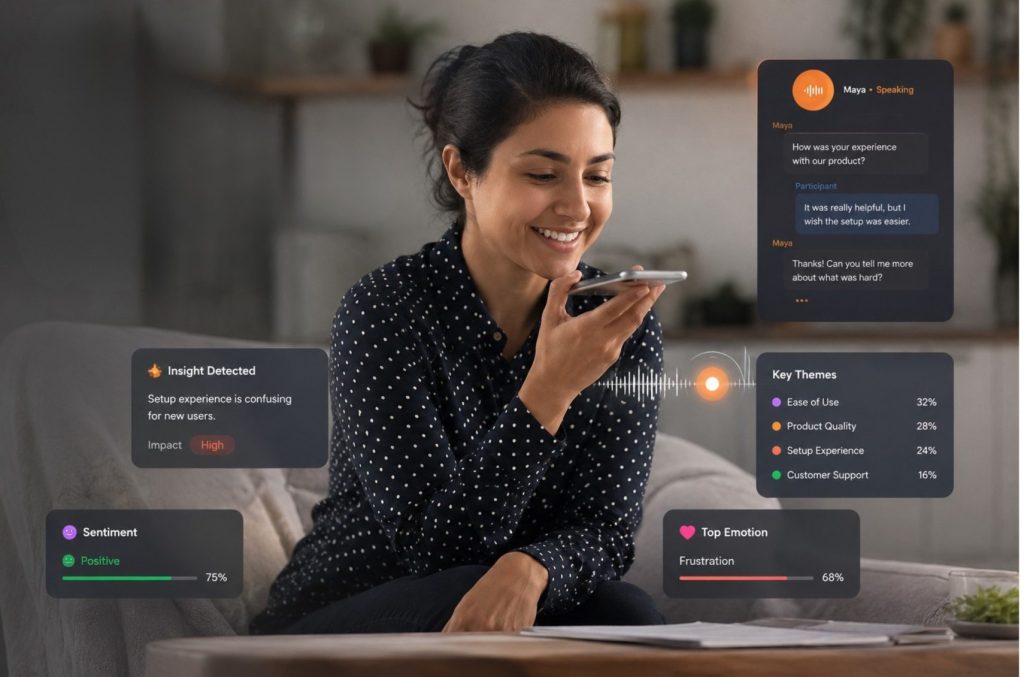
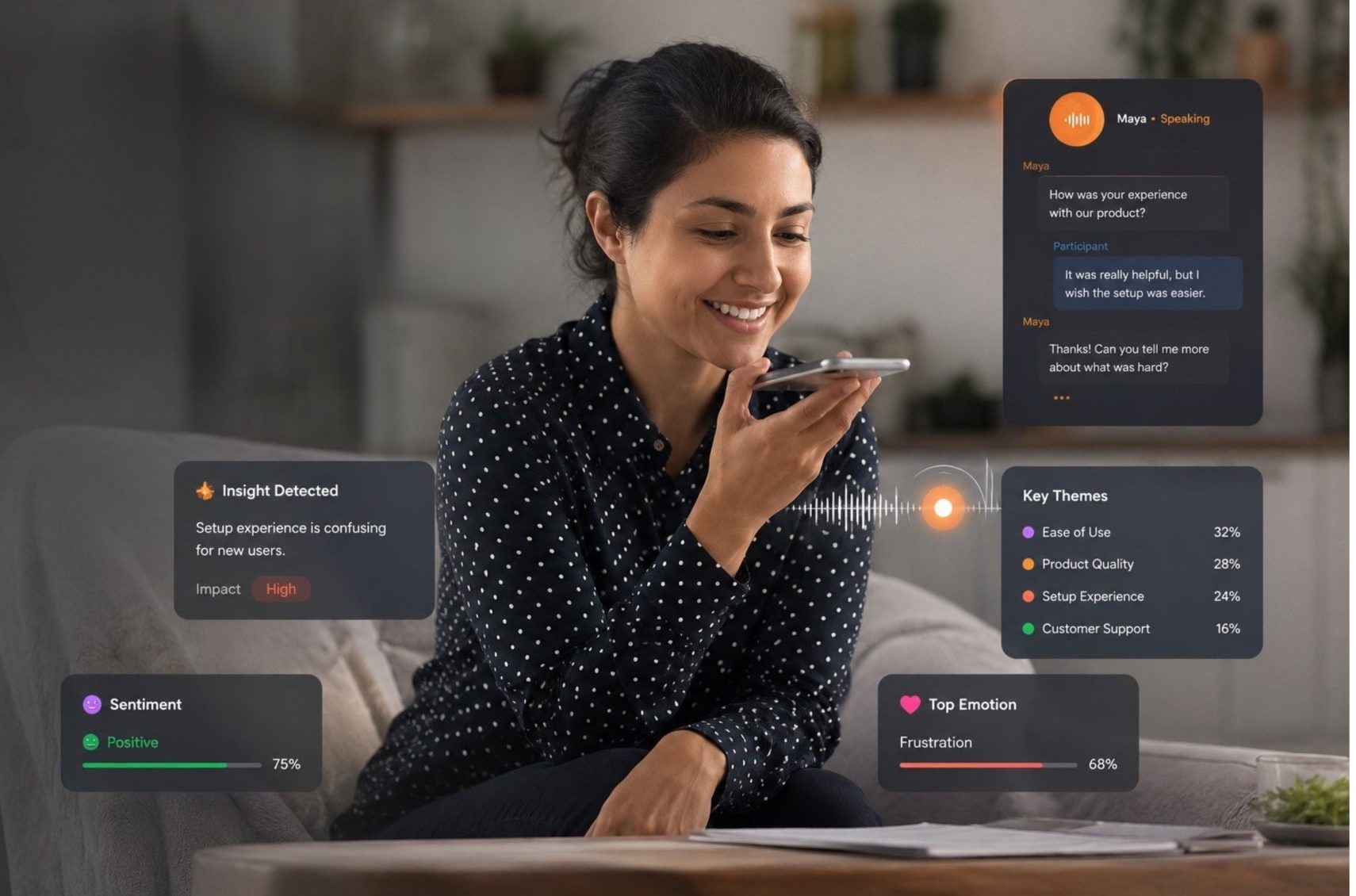
Maya AI, Merren’s qualitative research platform, brings pre-launch ad testing within reach of teams that don’t have a six-figure research budget or three spare weeks. Maya conducts AI-moderated interviews with real respondents. Talking to them like a human moderator, asking intelligent follow-up questions based on what each person actually says, and surfacing the why behind their reaction to your ad.
For ad testing specifically, that matters in a few concrete ways:
- You test the idea before you spend. Run your concept, script, or finished creative past real target consumers and find the confusing line or flat hook while it’s still cheap to fix not after media spend.
- You get the “why,” not just a score. A performance tool tells you variant B won. Maya tells you why it won, which message landed, which emotion it triggered, where attention dropped. It probes each respondent like a skilled interviewer would.
- It runs at the speed of a campaign. Maya conducts hundreds of interviews simultaneously across time zones and languages, then automatically codes, themes, and visualizes the results. Insights come back in hours or days, not weeks. Teams using Maya report cutting project turnaround by over 80%, with one wrapping a 30-interview concept test (with final analysis) in two days instead of three weeks.
- It captures authentic reactions. Since there’s no human moderator in the room, you get genuine emotional responses without moderator bias. Closer to how the ad will actually be received in the wild.
- It fits real workflows and budgets. Maya is designed to be roughly 10× faster and 5× more cost-efficient than traditional qualitative research, which is what makes pre-launch testing viable for teams who previously skipped it entirely.
Choose The Right Advertising Testing Tool
Start with the bottleneck, not the feature list:
- “We don’t know if our concept will land.”: Pre-launch consumer testing. Start with Maya AI by Merren.
- “We need to know which part of the ad generates more interest” : Neuro & emotion-based pre-testing. Use MIRA by Merren. .
- “We run lots of ads but can’t tell why some win.”: Creative analytics (Motion, Superads).
- “We don’t have enough creative variations to test.”: Creative generation (AdCreative.ai).
Best Neuromarketing Ad Testing Software
1. What is neuromarketing ad testing software?
Neuromarketing ad testing software measures how people biologically respond to an advertisement instead of relying on what they say about it. Traditional neuromarketing requires lab equipment like EEG headsets or fMRI scanners, which costs thousands of dollars per study and takes weeks. Newer AI-based tools replicate this without a lab: MIRA by Merren, for example, uses a model trained on roughly 1,000 hours of fMRI data to predict second-by-second brain response to an ad, combined with real-viewer gaze tracking and facial emotion analysis. The output shows exactly which moments of an ad hold attention, trigger emotion, or lose the viewer, before any media spend.
2. Can software measure emotional response to an ad without a lab?
Yes. AI-powered tools can now measure emotional response to ads remotely, without EEG caps, fMRI scanners, or a physical facility. MIRA by Merren does this in two layers: an fMRI-trained model predicts frame-by-frame brain activity for attention, memory, and decision-making, while real target consumers watch the ad on their own devices as their gaze and facial expressions are captured. MIRA scores seven emotions (delight, engagement, disengagement, friction, aesthetic appreciation, negative reaction, and surprise) from 0 to 100 with timestamped peaks. Results arrive the same day, compared to the weeks a lab-based biometric study typically takes.
3. How does AI-based neuromarketing compare to EEG or fMRI lab studies?
Lab-based EEG and fMRI studies are the gold standard for measuring raw neural activity, but they are expensive, slow, and limited to small samples in artificial viewing conditions. AI-based neuromarketing tools trade direct measurement for predicted measurement: MIRA’s brain-response layer is trained on fMRI data, so it predicts how a brain would respond to each second of an ad without putting anyone in a scanner. It then validates those predictions against real gaze and facial-emotion data from actual target viewers watching in natural conditions. The result is not a replacement for academic neuroscience, but for creative decisions it delivers comparable diagnostic value at a fraction of the cost and turnaround time.
4. Which parts of an ad does neuro-based testing diagnose that surveys cannot?
Surveys and interviews capture what viewers claim after watching, which misses anything they could not consciously report. Neuro-based testing captures what happened during viewing: the exact second attention drifted, whether the brand appeared during an engagement peak or a dead zone, which scene triggered friction, and whether the opening hook worked in the first three seconds. MIRA maps these against every frame and returns diagnostics scored 0 to 100 for attention grab, attention hold, memorability, message comprehension, likability, and brand connection. The two approaches work best together: neuro testing shows what happened, and follow-up interviews (for example with Maya AI) explain why.
5. Is neuromarketing ad testing affordable for small teams?
It is now. Traditional neuromarketing studies with EEG or biometric labs typically start in the tens of thousands of dollars, which restricted them to large CPG and enterprise brands. AI-based tools have collapsed that barrier: because MIRA’s brain-response prediction requires no lab, no equipment, and no recruited panel for its first layer, a single ad can be analyzed in about 20 minutes on pilot-based pricing. This puts neuro-level diagnostics within reach of teams that previously skipped pre-testing entirely.
Frequently Asked Questions
What is the best ad testing software in 2026?
It depends on your bottleneck. For post-launch optimization, performance tools like Madgicx lead. For pre-launch consumer feedback, Maya AI by Merren and Zappi are the main options. For biological measurement of ad response like predicted brain activity, gaze, and facial emotion before launch, MIRA by Merren is currently the only dedicated tool in this comparison.
What is the difference between A/B testing and ad pre-testing?
A/B testing compares live ad variants using real spend and measures which converts better as you learn after money is committed. Ad pre-testing evaluates the creative with real consumers (or, with MIRA, predicted brain response) before launch, so weaknesses are fixed while they’re still cheap to fix.
How much does ad testing software cost?
Performance automation tools typically run mid-to-high monthly SaaS pricing. Traditional pre-testing via focus groups costs $3,000–$15,000 per group. Enterprise platforms like Zappi and Smartly.io are custom-priced. MIRA and Maya by Merren offer pilot-based entry you can test a single ad first.
Cost of ad research, read here.
Can AI predict if an ad will work before launch?
Partially, yes. MIRA by Merren uses a model trained on ~1,000 hours of fMRI data to predict second-by-second brain response to an ad, validated against real-viewer gaze and facial emotion. It doesn’t predict sales outcomes, but it identifies where an ad gains or loses attention and whether the brand registers before media spend.
Test your ads before you spend with Maya AI
Maya AI by Merren lets you put your ad concepts, scripts, and creatives in front of real target consumers and get deep, structured insight back in hours not weeks. AI-moderated interviews, intelligent follow-ups, automatic analysis, and decision-ready reports, all at a fraction of the cost and time of traditional research.
Explore the full Merren platform to run consumer research across surveys, messaging channels, and AI-led interviews all in one place.