
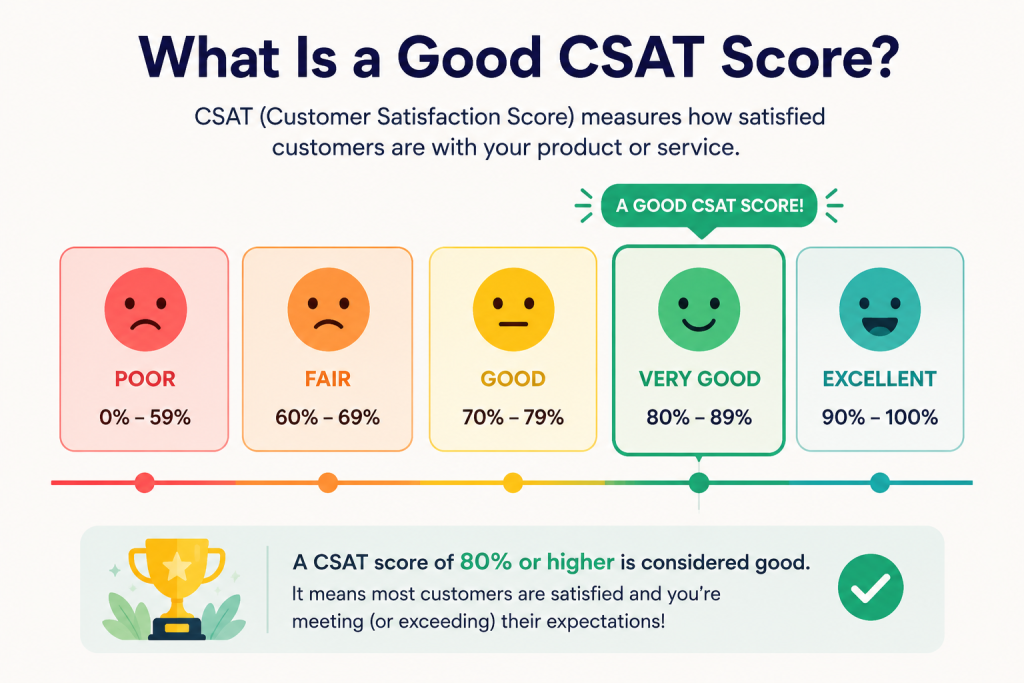
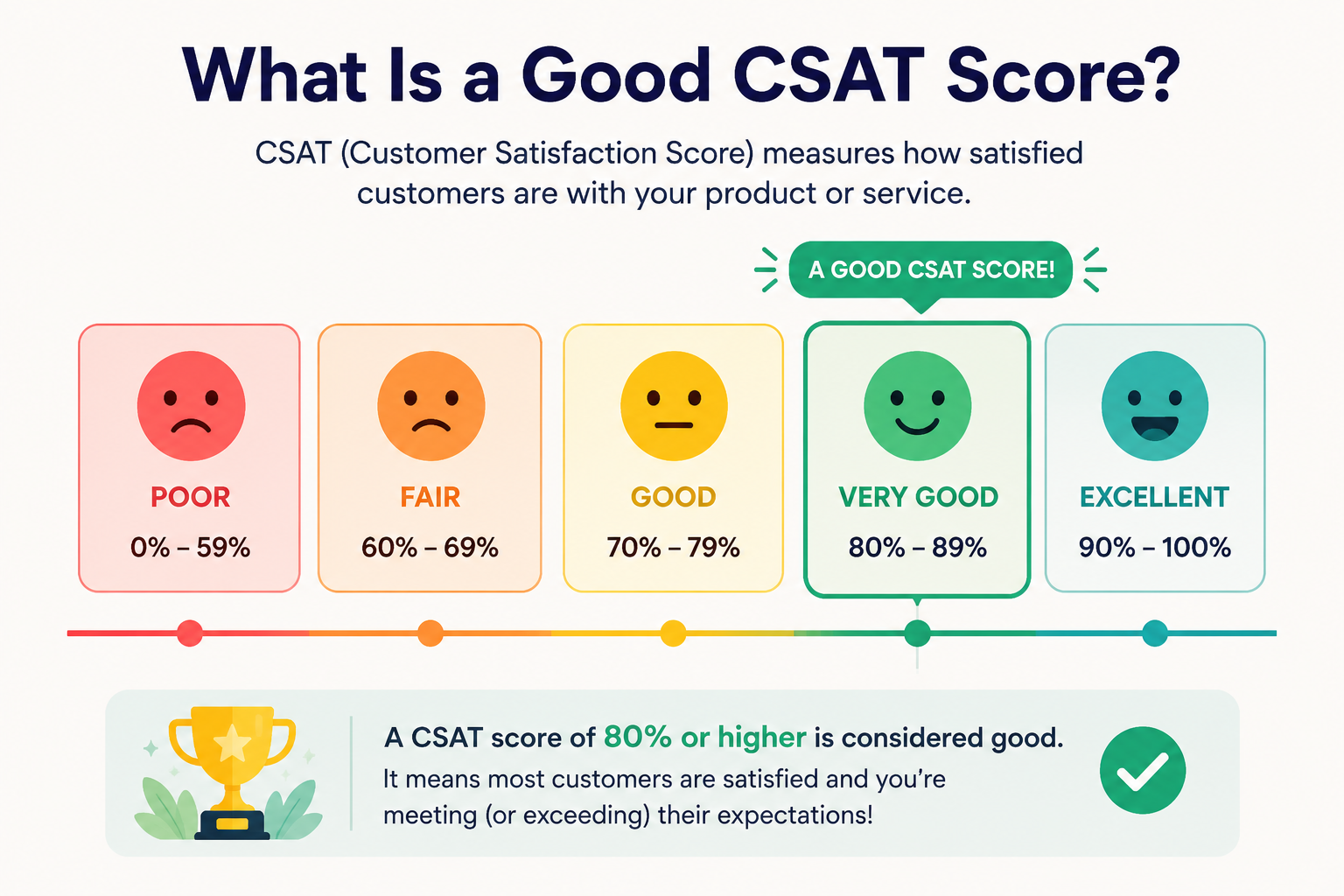
In 2026, a good CSAT score is generally 75% or higher, and 80%+ is considered excellent. The cross-industry benchmark sits at roughly 76–78%, but the “right” number depends entirely on your industry. Currently, 80% is average for a bank and outstanding for a telecom provider. This guide breaks down what a CSAT score is, how to calculate it, and the latest 2026 benchmarks by industry, responsive CSAT survey channel and support type.
What is a CSAT score?
A Customer Satisfaction Score (CSAT) measures how satisfied customers are with a specific product, service, or interaction. It’s usually captured right after a touchpoint such as a purchase, a support chat, or onboarding. It uses one simple question:
“How satisfied were you with your experience?”
Customers respond on a rating scale (most commonly 1 to 5). CSAT is then expressed as the percentage of customers who gave a positive rating (the top two options, e.g. 4 or 5 on a 5-point scale).
Since it’s tied to a single moment, CSAT is the most direct read on how customers feel right now which is why it sits alongside NPS (loyalty) and CES (effort) as one of the three core CX metrics.
How to calculate a CSAT score (formula)
CSAT % = (Number of satisfied responses ÷ Total responses) × 100
“Satisfied” means everyone who picked the top one or two options on your scale.
Example: If 150 of your 200 respondents rated their experience a 4 or 5, your CSAT score is:
(150 ÷ 200) × 100 = 75%
Common CSAT rating scales
- 1–5 scale: Very dissatisfied → Very satisfied (most popular). Count 4s and 5s as satisfied.
- 1–7 scale: More granular; count 5, 6 and 7 as satisfied.
- 1–10 scale: Common in larger studies; count 6 and above as satisfied.
- Emoji / star scales: Visual versions of the above — great for mobile, WhatsApp, and in-app surveys.
One thing to clarify: A survey CSAT (% satisfied) and an ACSI-style index score (a 0–100 weighted index, like the 76.7 U.S. national figure) are calculated differently. Both are reported on a 0–100 range, so always confirm which method a benchmark uses before comparing yourself to it.
What Is A Good CSAT Score in 2026?
There’s no universal metric, but these ranges hold up well across industries:
CSAT Score | Rating | What it means |
85–100% | Excellent | Best-in-class; strong loyalty and advocacy |
75–84% | Good | Solid satisfaction; small pockets to improve |
65–74% | Fair | Acceptable, but real friction exists |
Below 65% | Needs work | Significant dissatisfaction; act now |
A score of 80% and above is widely viewed as excellent, while 75%+ is good. Context is everything: complex, low-choice industries (telecom, insurance, government) naturally run lower, while financial services and SaaS run higher.
The 2026 trend you need to know: Customer satisfaction is under pressure. The American Customer Satisfaction Index (ACSI) fell to 76.7 out of 100 in Q1 2026, and customer complaints surged 16% in the same quarter. The bar for a “good” score isn’t rising but customer expectations are, which makes holding your score harder than it used to be.
Want CSAT surveys that run natively on WhatsApp, email, and Messenger?
CSAT Benchmarks By Industry (2026)
These benchmarks blend 2026 data from the American Customer Satisfaction Index (ACSI), Zendesk, Salesforce, and Freshdesk. Use them as a starting line — then always compare against your direct competitors, not just the cross-industry average.
Industry | Average CSAT (2026) | Strong performance |
Financial services / banking | 80–83% | 88%+ |
Software / SaaS | 79–80% | 88%+ |
E-commerce / retail | 78–80% | 87%+ |
Healthcare | 74–78% | 86%+ |
Insurance | 76–77% | 85%+ |
B2B professional services | 76% | 84%+ |
Utilities / energy | 73–74% | 82%+ |
Government / public sector | 73% | 81%+ |
Airlines / travel | 72–76% | 80%+ |
Cable / telecom & ISP | 62–73% | 76%+ |
Cross-industry average | ~76–78% | 86%+ |
Sources: ACSI 2026 industry studies; Zendesk CX Trends; Salesforce State of Service.
What this tells you: Banking and SaaS lead because of heavy CX investment and (for banks) regulatory pressure. Telecom and ISPs trail due to billing complexity, outages, and limited customer choice. A 78% in telecom can be top-quartile; the same 78% in banking is below average.
CSAT benchmarks by support channel
Channel often matters more than industry. Customers who reach you through their preferred channel and get a fast reply score noticeably higher.
Channel | Average CSAT | Why |
Live chat | ~85% | Fast and conversational |
Phone / voice | ~83% | Human connection, real-time |
Self-service (resolved) | ~82% | Instant when it works |
~74% | Slower, feels less attentive | |
AI chatbot (resolved) | ~74% | Strong for simple queries |
Social media (public) | ~68% | Slow, visible, high-stakes |
AI chatbot (failed, no escalation) | ~42% | The worst outcome in support |
Source: Zendesk CX Trends; Freshdesk Global Benchmark; Intercom 2025.
The standout lesson for 2026: an AI chatbot that fails to resolve an issue and fails to escalate gracefully scores around 42% worse than having no chatbot at all. If you’re deploying AI support, design the escalation path first.
What drives CSAT the most? Response time.
First response time is the single strongest predictor of CSAT. The data is unambiguous:
First response time (email) | Average CSAT |
Under 1 hour | ~86% |
1–4 hours | ~83% |
4–8 hours | ~79% |
8–24 hours | ~75% |
24–48 hours | ~72% |
Never responded | ~35% |
That’s a 14-point swing between replying within an hour versus a day later. Often the exact gap between top-quartile and bottom-quartile performers. For live chat, the inflection point is roughly 2 minutes of wait time; beyond 10 minutes, chat satisfaction falls below the email average.
CSAT vs NPS vs CES: how they differ
CSAT, NPS and CES are often used interchangeably. They shouldn’t be.
Metric | Measures | When it’s asked | Scale |
CSAT | Satisfaction with a specific interaction | Right after the interaction | 1–5 or 1–10 |
NPS | Likelihood to recommend the brand overall | Periodically | 0–10 |
CES | Effort needed to resolve an issue | After the interaction | 1–7 |
CSAT and NPS correlate only moderately, so a high NPS does not guarantee high CSAT on individual support tickets. For day-to-day support quality, pair CSAT with First Contact Resolution (FCR) ; they’re the two most tightly linked metrics in support operations.
8 Ways To Improve Your CSAT Score
1. Cut your first response time
It’s the highest-leverage fix. Set SLAs, route smartly, and use automation to acknowledge instantly even when resolution takes longer.
2. Solve it on the first contact
First Contact Resolution and CSAT move together. Every issue resolved on contact #1 also reduces repeat tickets, freeing the capacity to answer everyone faster.
3. Offer communication channel of choice
Let customers reach you where they already are: WhatsApp, email, chat, and Messenger. Forcing customers onto a non-preferred channel drags CSAT down.
4. Design AI chatbots to escalate well
A bot that resolves simple queries is great. A bot that traps customers in a loop is the worst-scoring experience in support. Build a clean handoff to a human.
5. Add a human touch
Use names, remember preferences, and personalize follow-ups. Small signals of recognition lift satisfaction measurably.
6. Train for empathy, not just speed
Active listening and genuine empathy turn a frustrated customer into a loyal one — even when the answer is “no.”
7. Close the feedback loop
Don’t just collect CSAT but act on it. Top-quartile teams review CSAT weekly and link it to agent coaching. Bottom-quartile teams report it quarterly and change nothing.
8. Benchmark continuously
Track your trend line, not just your average. Moving from 72% to 78% is real progress even if you’re not yet “excellent.” Compare against direct competitors, and watch your score distribution not just the headline number.
What To Do With The CSAT Results?
- High scores (80%+): Reward loyal customers, request testimonials, and document what’s working so you can repeat it.
- Medium scores (65–79%): Dig into the distribution. Identify the specific touchpoints dragging you down and follow up with detractors.
- Low scores (below 65%): Treat it as urgent. Find the root cause, fix it fast, and personally follow up with dissatisfied customers to rebuild trust.
Frequently Asked Questions
What is a good CSAT score in 2026?
A good CSAT score is generally 75% or higher, with 80%+ considered excellent. The cross-industry average is around 76–78%. Compare against your specific industry, not just the overall average.
What is a CSAT score?
It’s the percentage of customers who rate a product, service, or interaction positively (the top one or two options on a satisfaction scale), calculated as satisfied responses ÷ total responses × 100.
What is the average CSAT score for SaaS companies?
SaaS and software companies average roughly 79–80% in 2026, slightly above the cross-industry average. Top performers reach 88%+, and scores are highly sensitive to response time and first contact resolution.
Is a CSAT of 70% good? It depends on your industry. 70% is below average for banking or SaaS but can be solid or even strong in telecom, insurance, or government, where satisfaction naturally runs lower.
What’s the difference between CSAT and NPS?
CSAT measures satisfaction with a specific interaction; NPS measures overall likelihood to recommend the brand. They correlate only moderately, so a high NPS doesn’t guarantee high CSAT.
Start measuring CSAT the right way
A good CSAT score in 2026 starts with collecting reliable, real-time feedback on the channels your customers actually use. Merren lets you run automated CSAT surveys over WhatsApp, email, and Messenger, track results in a live CX dashboard, and close the loop on unhappy customers.