


The 5 Categories of Advertising Research (And What Each Costs)
1. Pre-campaign research: testing before you spend
This is the highest-leverage category. Research conducted before a campaign launches prevents the most expensive mistake in advertising: spending a large media budget on a message that doesn’t work.
What it includes:
- Concept testing: Exposing target consumers to multiple creative directions (usually rough mockups or storyboards) and measuring emotional response, message clarity, and purchase intent
- Copy testing: Testing specific headlines, body copy, and calls-to-action
- Storyboard / animatic testing: Used in TV and video advertising to evaluate executions before full production
What it costs:
In the US, a full concept test using an online survey methodology with 200–400 respondents typically costs $8,000–$20,000 (survey programming, panel recruitment, analysis, and a topline report). If it involves focus groups for deeper qualitative exploration, add $15,000–$35,000 for 2–3 groups.
In India, the equivalent online concept test runs $2,000–$6,000. Focus groups for pre-campaign research in India cost $3,000–$8,000 for 2–3 sessions in a single city.
For brands using this AI-moderated qualitative research can get pre-campaign concept interviews with 20–40 consumers completed in under a week for 5 times lesser the cost. Additionally, clients get multilingual capability and thematic analysis included.
When to use it: Before any campaign where media investment exceeds $50,000. The research cost is typically 2–5% of media spend. It can prevent the full 100% being wasted on a non-resonant campaign.
2. Digital advertising research: testing, measurement and optimization
Digital advertising research is one of the fastest-growing sub-categories of advertising market research. Digital campaigns are uniquely measurable and yet most brands still under-invest in structured research to understand why their campaigns perform or underperform.
What it includes:
- A/B and multivariate ad testing — systematic testing of headlines, images, CTAs, and audience segments
- Platform-level analysis — using first-party and third-party data to understand performance by channel (Google Search, Meta, YouTube, LinkedIn, etc.)
- Digital ad recall surveys — surveying exposed vs. unexposed audiences to measure lift in brand recall, message association, and purchase intent
- Customer journey analysis — understanding how digital touchpoints work together to move someone from awareness to conversion
What it costs:
The cost of digital advertising research depends heavily on whether you’re using platform-native tools (Google’s Brand Lift, Meta’s Conversion Lift often free to large spenders) or commissioning independent third-party research for unbiased measurement.
- Platform-native brand lift studies (Google, Meta): Free for advertisers meeting minimum spend thresholds ($50,000+ in most markets), but results are platform-controlled and not independently validated
- Independent digital ad recall surveys (200–400 respondents, exposed vs. control split): $5,000–$18,000
- Structured A/B testing with analysis and reporting: $3,000–$12,000 for a single campaign cycle
- Social listening and digital share-of-voice analysis: $3,000–$8,000/month for ongoing monitoring
In parts of Asia, independent digital advertising research runs significantly lower. Typically $1,200–$5,000 for an equivalent survey study making it accessible for growth-stage brands running regional digital campaigns.
The hidden cost of skipping digital advertising research: According to industry benchmarks, brands that conduct structured digital advertising research and use findings to optimize creative and targeting typically see a 15–30% improvement in cost-per-acquisition versus brands relying purely on platform-generated data. Research that costs $10,000 can generate six-figure savings in wasted media spend.
3. Post-campaign measurement: proving ROI after the campaign runs
Post-campaign advertising research answers the question every CMO gets asked: Did the advertising actually work?
What it includes:
- Advertising recall studies — measuring unaided and aided recall of specific ads or campaigns
- Brand lift measurement — tracking changes in awareness, favorability, purchase intent, and brand associations before and after a campaign
- Sales lift / revenue attribution — correlating advertising exposure to purchasing behavior (the most complex and expensive category)
- Media mix modeling (MMM) — statistical modeling of the contribution of each channel to overall business outcomes
What it costs:
Method | US Cost | India Cost |
Post-campaign recall survey (n=400) | $6,000–$15,000 | $1,500–$5,000 |
Brand lift study (pre/post wave design) | $12,000–$35,000 | $3,000–$10,000 |
Sales lift analysis (panel-based) | $20,000–$60,000 | $8,000–$20,000 |
Media Mix Modeling (MMM) | $50,000–$500,000+ | $15,000–$80,000 |
Media Mix Modeling deserves special attention because it’s the gold standard of advertising ROI measurement and the most expensive. A full MMM engagement for an enterprise brand with multi-channel spend typically requires 2–3 years of weekly sales and media data and costs $100,000–$500,000 in the US. Lighter, AI-assisted MMM solutions available from specialist vendors have emerged at the $50,000–$150,000 range for brands with simpler media mixes.
4. Competitive advertising research: understanding your category
Knowing what competitors are spending, where they’re advertising, and what messages they’re using is its own form of advertising research and the most underutilized one.
What it includes:
- Competitive media spend analysis — estimating share of voice across channels
- Creative audit — systematic review of competitor ad content and messaging themes
- Category advertising benchmarking — understanding CPM/CPC norms for your sector
- Consumer perception of competitor advertising — qualitative or survey research on how competitors’ ads land
What it costs:
- Syndicated competitive spend data (Kantar CMAG, Nielsen Ad Intel): $15,000–$100,000/year for licensed access
- Custom competitive creative audit (manual + AI-assisted): $5,000–$15,000
- Consumer-facing competitor ad perception study: $8,000–$20,000 (US); $2,000–$6,000 (India)
5. In-campaign / real-time advertising research
The ability to course-correct during a campaign is one of the most valuable forms of advertising research.
What it includes:
- Pulse surveys — short, fast surveys (5–8 questions) deployed every 2–4 weeks during a campaign to track changes in brand metrics
- Social sentiment monitoring — real-time tracking of how audiences respond to advertising on social media
- Rapid creative testing — using AI tools to deploy and evaluate 3–5 creative variants against real audiences in 48–72 hours
What it costs:
- Pulse survey program (monthly wave, n=200): $3,000–$8,000/month (US); $800–$2,500/month (India)
- Social sentiment monitoring: $2,000–$5,000/month for a dedicated analyst + tools
- Rapid AI-led creative testing (Merren Maya AI, 20–30 interviews): $1,000–$3,000 per round, results in 3–5 days
What Drives the Cost of Advertising Research? The 7 Key Variables
Understanding these variables gives you the power to control your advertising research budget without sacrificing the quality of insight:
1. Number of creative variants being tested
Every concept, headline, or execution that needs to be tested adds cost. Testing 2 concepts against each other requires roughly double the sample of a monadic test. Most concept testing studies evaluate 3–5 variants and need either sequential or split-sample designs, which directly increases panel and analysis costs.
Budget impact: Each additional creative variant typically adds $1,500–$4,000 to a concept testing study, depending on methodology.
2. Target audience complexity
Testing advertising with general consumers (adults 18–54) costs a fraction of testing with hard-to-reach segments. A study testing digital banking ads among high-net-worth individuals in the US, or testing agricultural input advertising with marginal farmers in rural India. Each requires specialized recruitment that can multiply costs 3–5x versus general population research.
As covered in our qualitative research cost guide, specialist audiences like doctors, C-suite executives, or niche B2B decision-makers carry recruitment costs of $200–$2,000 per respondent, the same applies in advertising research contexts.
3. Methodology: quantitative vs. qualitative vs. hybrid
Quantitative advertising research (online surveys) gives you statistical confidence and directional performance scores at lower per-respondent cost. Qualitative advertising research (focus groups, in-depth interviews) bring out data richness. The language consumers use, the emotional subtleties, the reasons behind reactions but at higher per-respondent cost.
Most sophisticated advertising research programs use both:
- Qualitative first to explore and iterate
- Quantitative after to validate at scale
Hybrid programs in the US typically cost $25,000–$60,000 for a single-market study. In India, equivalent hybrid programs run $6,000–$18,000.
4. Speed of delivery
Standard advertising research timelines run 2–4 weeks for quantitative and 3–6 weeks for qualitative. When launch timelines compress, rush fees add 20–40% to standard costs.
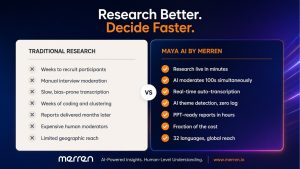
AI-moderated platforms (like Maya by Merren) have structurally changed this dynamic. A 30-interview qualitative advertising concept study can now be completed in 3–5 days at significantly lower cost than traditional moderated research.
5. Geography and number of markets
Single-market advertising research is the baseline. Every market added multiplies costs:
- Each additional country: +20–40% of baseline cost for translation, localization, local panel, and data harmonization
- India urban vs. rural: Rural research adds logistics, moderator travel, and local language requirements that can increase per-respondent costs by 30–50%
- US multi-region: If regional variation matters (Southeast vs. Northeast vs. West Coast consumer response to an ad), expect larger samples and a 25–40% cost premium
6. Mode of research
- Online surveys: Most cost-efficient for quantitative advertising research
- CATI (phone surveys): 2–3x more expensive than online; used when digital penetration is low
- In-person focus groups: Highest cost; justified for high-stakes pre-production ad testing
- AI-moderated interviews: 60–80% lower than human-moderated equivalents; fastest delivery
- Neuroscience / biometric testing (eye-tracking, EEG): 3–5x premium over standard methods; used for packaging and high-investment TV creative
7. Depth of analysis and reporting
Raw data is cheap. Insight is expensive. Trained researchers interpret why consumers responded as they did, what this means for the brief and how to improve the creative. This analysis phase of advertising research is often the single biggest value driver and a significant cost center.
- Topline summary report: Typically included in standard packages
- Full analysis deck with strategic recommendations: Adds $2,000–$8,000 above raw reporting
- Executive presentation / workshop facilitation: Adds $3,000–$12,000
- AI-assisted analysis with human interpretation layer: Emerging standard reduces cost 40–60% vs. fully manual analysis
Advertising Research Costs by Business Stage
Startups and early-stage brands (budget: $2,000–$15,000)
At this stage, the goal is directional validation, not statistical perfection. Recommended approach:
- 10–15 AI-led concept interviews using a tool like Maya AI by Merren: $1,500–$4,000
- A rapid online survey (n=150–200) to score top 2 concepts: $3,000–$7,000
- Social sentiment snapshot for category: $1,000–$2,000
Total: $5,500–$13,000 enough to make a go/no-go creative decision with genuine consumer evidence.
Growth-stage brands (budget: $20,000–$75,000)
At this stage, advertising research should become a regular part of every major campaign cycle:
- Pre-campaign concept testing (2–3 concepts, hybrid qual + quant): $15,000–$30,000
- In-campaign pulse tracking (2–3 waves): $6,000–$15,000
- Post-campaign brand lift study: $10,000–$20,000
Total: $31,000–$65,000/year an investment that typically pays back many times over by improving media efficiency.
Enterprise / mid-market brands (budget: $75,000–$500,000+)
Enterprise advertising research programs are multi-wave, multi-market, and often include econometric modeling:
- Annual concept testing across 3–4 campaigns: $40,000–$100,000
- Continuous brand tracking with advertising diagnostics: $50,000–$120,000/year
- Media Mix Modeling: $100,000–$500,000+
- Multi-market digital advertising research: $50,000–$150,000/year
Advertising Research in India vs. the US: Cost Comparison
India represents a unique and fast-growing market for advertising research investment. The country’s rapid digital advertising growth with over 800 million internet users and digital ad spend is projected to exceed $10 billion by 2027.
The good news: advertising research in India costs 4–7x less than equivalent US research, with no sacrifice in methodological rigor when conducted with a reputable agency or AI-powered platform.
Research Type | US Cost | India Cost | Cost Ratio |
Online concept test (n=300) | $10,000–$18,000 | $2,000–$5,000 | 4–6x |
3 pre-campaign focus groups | $20,000–$35,000 | $4,000–$10,000 | 4–5x |
AI-led ad concept interviews (30) | $2,500–$5,000 | $1,000–$2,500 | 2–3x |
Post-campaign brand lift survey | $10,000–$20,000 | $2,500–$6,000 | 4–5x |
Competitive advertising audit | $8,000–$15,000 | $2,000–$5,000 | 3–4x |
Critical nuance for India research: Urban-rural splits, multi-language requirements (Hindi, Tamil, Bengali, Telugu, and others depending on geography), and varying digital literacy levels add complexity and cost to India-based advertising research. Plan for a 20–35% cost premium for studies that need to cover Tier 2 and Tier 3 cities versus metro-only research.
Digital Advertising Research: What the Platforms Give You for Free (and What They Don’t)
Digital platforms such as Google, Meta, YouTube, LinkedIn offer built-in advertising research tools that are free to large spenders. Understanding what these tools do and don’t measure is important for budgeting.
What platform-native tools provide:
- Reach and frequency data
- Click-through rates, conversion rates, cost-per-acquisition
- Brand Lift surveys (available to advertisers spending $50,000+ on Google; variable thresholds on Meta)
- Audience demographic and interest data
What they don’t provide:
- Competitor-benchmarked performance context
- Unbiased measurement (platform tools have structural incentives to show their channel in a positive light)
- Cross-platform attribution (each platform takes full credit for conversions)
- Qualitative understanding of why audiences respond or don’t respond
- Emotional resonance and subconscious response data
Independent advertising research commissioned by the brand, not the platform fills this gap. As digital advertising costs continue to rise (Google Search Ads average $2.32 CPC across all industries; LinkedIn averages $5.26 CPC; competitive verticals like financial services see $25–$100 CPC), the value of independent research to optimize that spend has never been higher.
AI’s Impact on Advertising Research Costs in 2026
The same structural shift that is transforming qualitative research costs is reshaping advertising research budgets. AI-moderated research platforms have made several previously expensive capabilities accessible at a fraction of traditional cost.
Advertising Research Activity | Traditional Cost | AI-Powered Cost (2026) | Savings |
30 qualitative ad concept interviews | $20,000–$35,000 | $3,000–$6,000 | 75–85% |
Open-end ad response coding (500 verbatims) | $3,000–$8,000 | $300–$1,000 | 80–90% |
Ad copy testing (10 variants) | $12,000–$25,000 | $3,000–$7,000 | 65–80% |
Automated theme identification from ad feedback | $4,000–$10,000 | $500–$2,000 | 75–85% |
Multilingual concept testing (3 languages) | $25,000–$50,000 | $6,000–$14,000 | 70–80% |
The cost revolution in neuro-based ad testing
The steepest cost collapse in advertising research is happening in its most expensive category. Traditional neuroscience ad testing such as lab-based EEG, eye-tracking hardware, recruited panels physically watching screens has historically cost $15,000–$50,000 per study and taken weeks. So only enterprise brands with high-stakes TV creative ever used it.
MIRA (Multi Input Response Agent for Ads) by Merren changes the economics of that category. Instead of a physical lab, MIRA uses an AI model trained on roughly 1,000 hours of fMRI data to predict second-by-second brain response to an ad. It takes no lab, no EEG caps, with a predictive read delivered in about 20 minutes. Real target consumers then watch the ad through their own webcams while MIRA captures gaze and facial emotion across seven scored emotion families, fusing all three signals into one engagement curve with 0–100 creative diagnostics (Attention Hold, Brand Connection, Memorability, and more).
The result: neuro-level depth at a pilot-level price. You see the exact second your brand lands in a dead zone for under 1% of the media budget it protects.
Learn how MIRA’s biology-based ad pre-testing works →
How to Build an Advertising Research Budget: A Step-by-Step Framework
Step 1: Define the advertising decision at stake
Every advertising research project should exist to answer a specific business question. “Does creative A or B better convey our brand’s affordability message to first-time home buyers in Mumbai?” is a well-defined question. “Is our advertising good?” is not. Decision clarity directly controls scope, method and cost.
Step 2: Map research to campaign timeline
Work backward from campaign launch. Pre-production concept testing needs to happen 8–12 weeks before launch. Copy testing, 4–6 weeks. Brand lift measurement, ongoing from launch through 4 weeks post-flight. Map the timeline first; it determines whether standard or rush-fee pricing applies.
Step 3: Choose method based on the type of insight needed
- Do you need to choose between concepts? Quantitative concept test
- Do you need to understand why an ad isn’t working? Qualitative interviews or groups
- Do you need to measure whether the campaign lifted brand metrics? Pre-post survey wave design
- Do you need to attribute sales to specific channels? Media Mix Modeling
Step 4: Set the sample size to the decision risk
Allocate research investment proportionally to the risk of the advertising decision. A $5 million campaign deserves $50,000–$150,000 in research (1–3% of media budget).
A $50,000 campaign can be adequately de-risked with $5,000–$10,000 in research.
Don’t spend $30,000 testing creative for a $20,000 campaign.
Step 5: Include a 10–15% contingency buffer
As noted in advertising budget planning best practices. A 10–15% contingency reserve protects against unexpected costs: harder-than-anticipated recruitment, extended fieldwork, additional analysis requested by stakeholders or timeline compression.
Common Mistakes That Inflate Advertising Research Budgets
Testing too many concepts too late. The most expensive version of concept testing is the one that happens after significant production investment. Test early, when changes are cheap.
Using in-person focus groups when online or AI methods deliver the same answer. In-person groups add facility, travel, and logistics costs that can represent 30–40% of total budget. For most concept testing and message resonance questions, online or AI-moderated approaches deliver equivalent insight.
Not defining a decision threshold before fieldwork begins. If the team hasn’t agreed on “we will go with concept A if it scores 10+ points above concept B on purchase intent,” the research ends without a clear decision — and often triggers additional rounds of research, doubling the cost.
Relying exclusively on platform-native data for digital advertising research. Platform tools measure what platforms want to measure. Independent research fills the gaps that platform data structurally cannot.
Skipping advertising research entirely for “small” campaigns. A $30,000 media spend without any creative testing is a $30,000 bet with no odds calculation. Even a $3,000 rapid AI-led concept study substantially improves the probability of a positive return.
Frequently Asked Questions: Advertising Research Costs
What does advertising research cost in 2026?
Advertising research costs range from $1,500 for a rapid AI-led concept test to $500,000+ for a full media mix modeling engagement. A typical mid-market pre-campaign concept test in the US runs $10,000–$25,000. Equivalent research in India costs $2,500–$7,000.
What is the difference between advertising research and market research?
Advertising research is a specialized sub-category of market research focused specifically on evaluating advertising messages, creative executions, and media performance. While general market research answers questions about who customers are and what they want, advertising research answers whether a specific ad resonates, is recalled, and drives the intended action. The cost structures overlap but differ in the emphasis on creative variant testing and campaign timing.
How much does digital advertising research cost?
Digital advertising research ranges from $3,000 for a structured A/B testing analysis to $50,000+ for a full independent brand lift study with pre/post wave design. Platform-native tools (Google Brand Lift, Meta Conversion Lift) are available free to large spenders but have measurement limitations that independent research addresses.
How much does neuromarketing or neuroscience ad testing cost?
Traditional lab-based neuroscience ad testing (EEG, eye-tracking) costs $15,000–$50,000 per study in the US. AI-based alternatives have changed this: MIRA by Merren predicts second-by-second brain response using an fMRI-trained model and captures real-viewer gaze and facial emotion via webcam. It delivers neuro-level diagnostics at pilot-based pricing at a fraction of traditional lab costs.
What is the cheapest way to test an ad before launch?
Platform A/B testing is free but only works after spend begins. For true pre-launch testing, AI-led options are the most affordable entry points: AI-moderated concept interviews (Maya by Merren) run $1,000–$6,000, and AI neuro pre-testing (MIRA by Merren) is available on a pilot basis for a single ad. Both cost a small fraction of the media spend they de-risk.
How much does ad concept testing cost?
An online ad concept test in the US with 200–400 respondents typically costs $8,000–$20,000 full service. AI-led qualitative concept testing (20–30 interviews) costs $1,500–$5,000 and delivers results in 3–5 days. In India, equivalent quantitative concept tests run $2,000–$6,000.
Is advertising research worth the cost?
Advertising research typically costs 1–5% of the media budget. Given that poorly tested campaigns waste 100% of media spend on non-resonant creative, the ROI of advertising research is consistently strong. Research that costs $15,000 that prevents the waste of a $300,000 media investment has a 20x return on the first application.
How is advertising research different in India versus the US?
India-based advertising research costs 4–7x less than equivalent US research. However, effective India advertising research requires multi-language capability (often 3–5 regional languages for national campaigns), urban-rural sample design, and sensitivity to the significant diversity within the Indian consumer market. AI platforms with multilingual moderation capability are particularly valuable in this context.
What is Media Mix Modeling and how much does it cost?
Media Mix Modeling (MMM) is an econometric technique that uses historical sales and media spend data to quantify the contribution of each advertising channel to overall revenue. Full-service MMM engagements for enterprise brands cost $100,000–$500,000 in the US. Lighter AI-assisted MMM solutions have emerged at $50,000–$150,000. In India, MMM projects typically run $15,000–$80,000 depending on scope.
Can AI replace traditional advertising research?
AI-powered platforms significantly reduce the cost and timeline of advertising research. It delivers 60–80% cost savings for concept testing, copy testing, and message resonance studies. For strategic pre-production decisions, AI-moderated research (like Maya AI by Merren) provides sufficient depth for most advertisers. For the highest-stakes creative decisions, AI and human expertise work best together.
Ready to run advertising research without the traditional price tag?
Test your next ad with MIRA — AI-predicted brain response, gaze, and emotion diagnostics on a pilot basis. Or explore Maya AI for AI-moderated qualitative interviews at 60–80% below traditional cost.
Related reading: